Internal systems Sheridan Capital
SC Credit is the originator's desk. A broker's email arrives, and from that moment the deal has a stage, a model, a screen, a diligence checklist and a number attached to it. Nothing lives in an inbox.
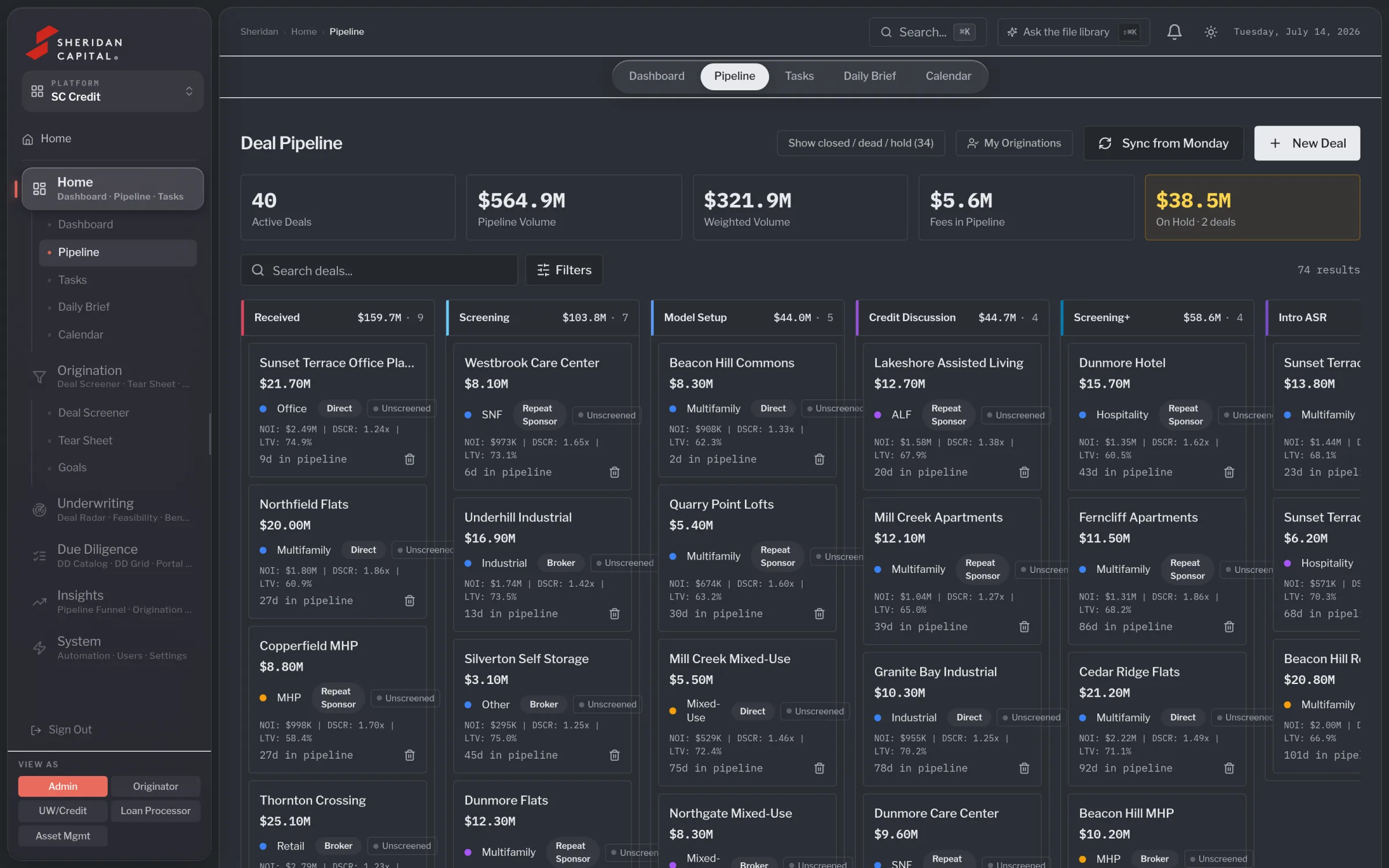
Every screen on this page is a real screenshot of the platform, captured against a synthetic book. No borrower, sponsor, property, balance or date shown anywhere is real. Both themes ship; the toggle in the header flips this page and every screen on it.
01 Why we built it
An originator sees far more deals than the firm will ever close. Most of the work is deciding, quickly and repeatedly, which ones are worth another hour. That decision is judgment, and judgment does not scale by working later.
What was slowing it down wasn't the judgment. It was everything around it. A deal arrives as an email with a rent roll attached. Somebody keys it into a board. Somebody else builds a model. The screen happens in a head, or in a reply thread. By the time the deal reaches credit, half the reasoning that got it there has evaporated, and the question "why is this one still alive" has no answer you can point at.
So the platform holds the reasoning, not just the record. Each deal carries its screen, its model, its variance against the sponsor's proforma, its diligence state and its stage clock. The originator's judgment is still the thing that matters. It is just written down, in the same place, every time.
Any deal in the pipeline can be opened and answered for in under a minute, by someone who has never seen it before.
02 The system
SC Credit is one of three platforms behind the firm's sign-in, alongside the Command Center and CRM. It owns the front half of a deal's life: everything from the broker's first email to the signed commitment, at which point the Command Center takes over.
Its sidebar is the shape of the work. Home is the day. Origination is bringing deals in. Underwriting is deciding on them. Due Diligence is proving them out. Insights is asking whether the whole thing is working.
01
/
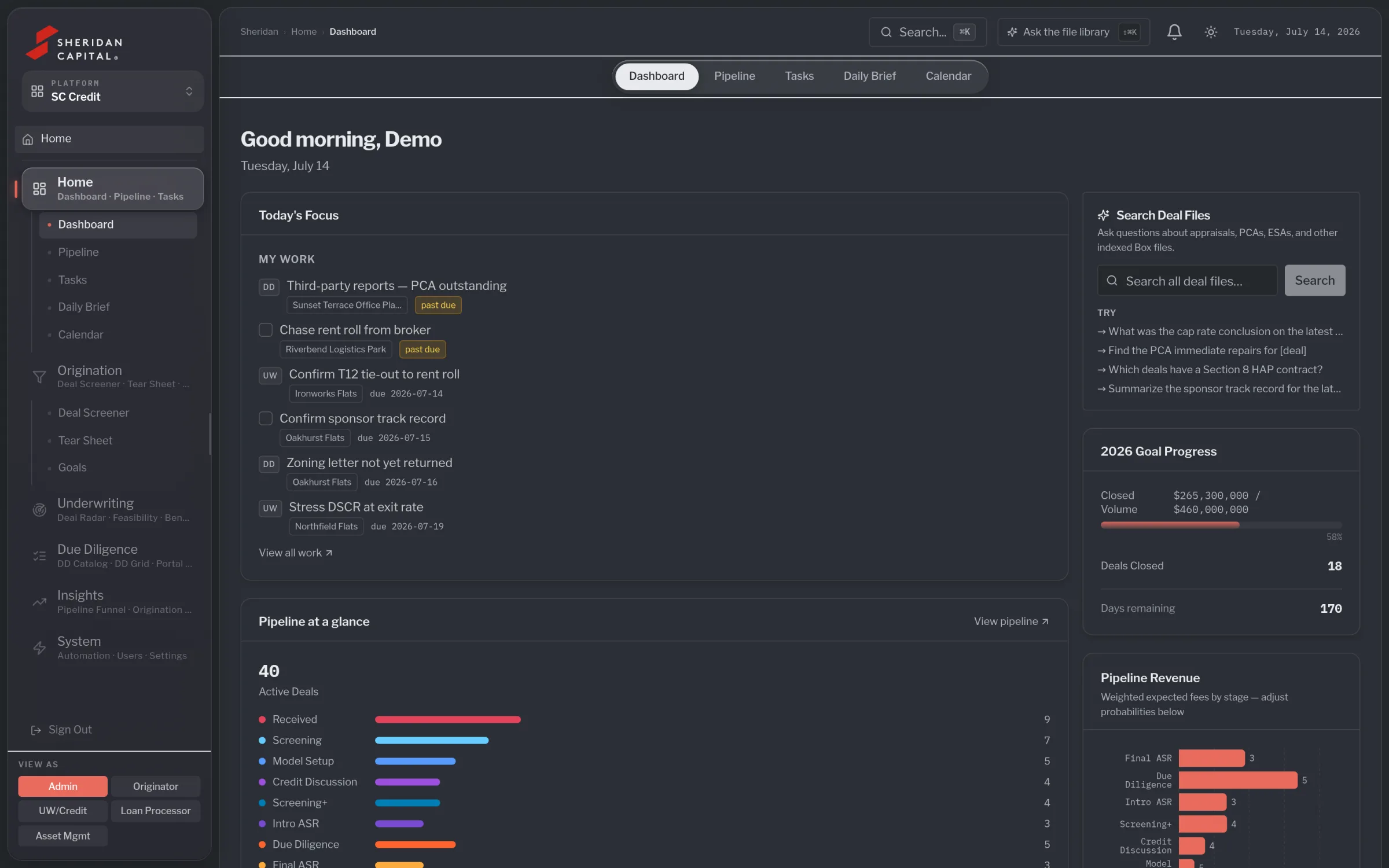
What is actually on you today, ahead of anything else on the page: open tasks, assigned diligence items and underwriting items, in one list, past-due first. Beside it the pipeline by stage, the year's closed volume against the firm target, and weighted expected fees by stage. The point of the screen is that it is short.
02
/deals
The whole live book as a board, one column per stage, from emailed items through screening, model setup, credit discussion, intro ASR, diligence and final submission. Each card carries the loan amount, the asset type, whether it came direct or through a broker, whether the sponsor is a repeat, and NOI, DSCR and LTV. Above the board, active count, pipeline volume, weighted volume, fees and what is on hold. A card that has been sitting says so on its face.
03
/screening
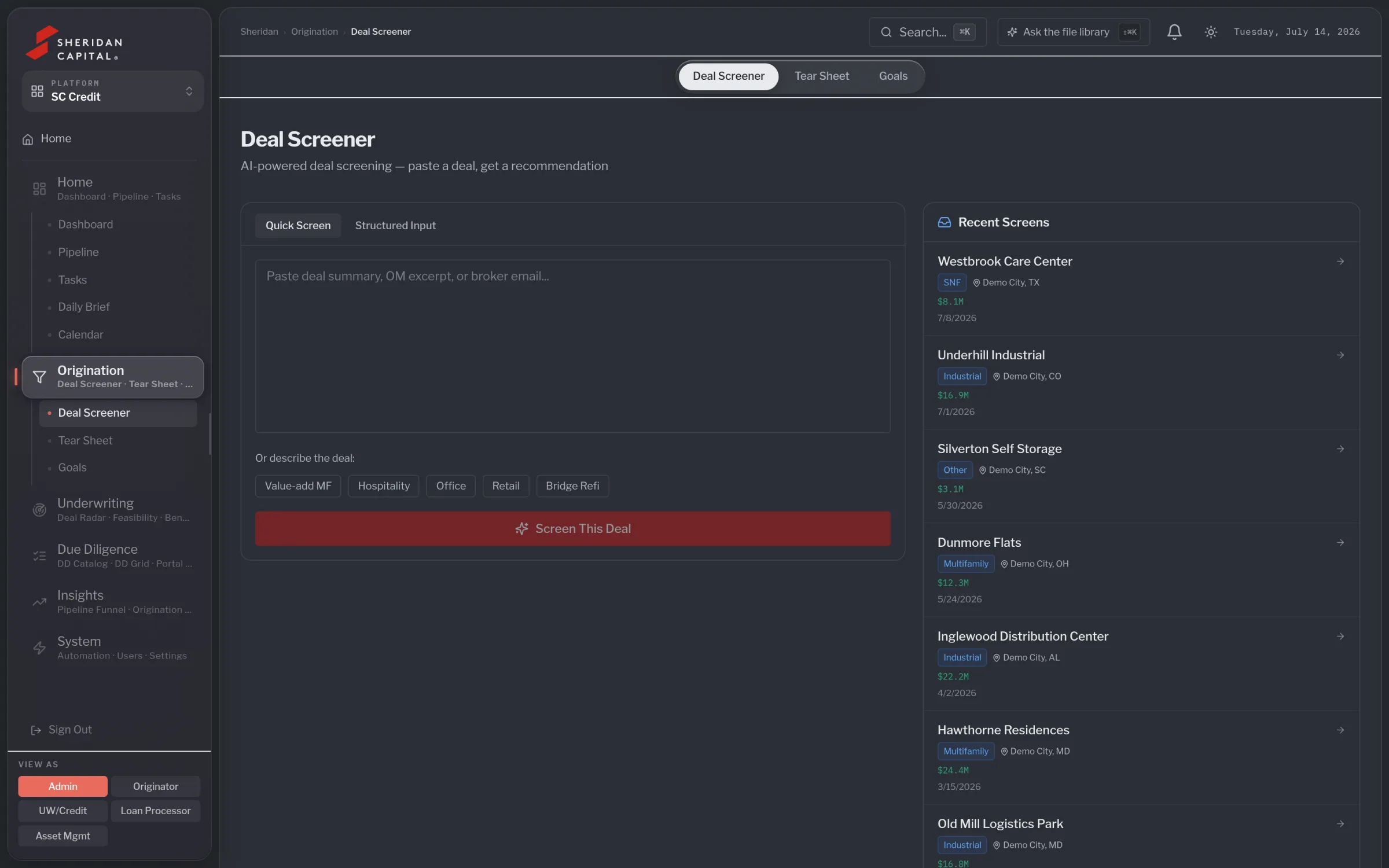
Paste the broker's email, an OM excerpt or a deal summary and get a recommendation back. Not to replace the originator's read, but to make the first pass consistent and to leave a trace of it. Every screen is kept, so the recent-screens rail beside the input is a record of what came in this week and what we said about it at the time.
04
/feasibility
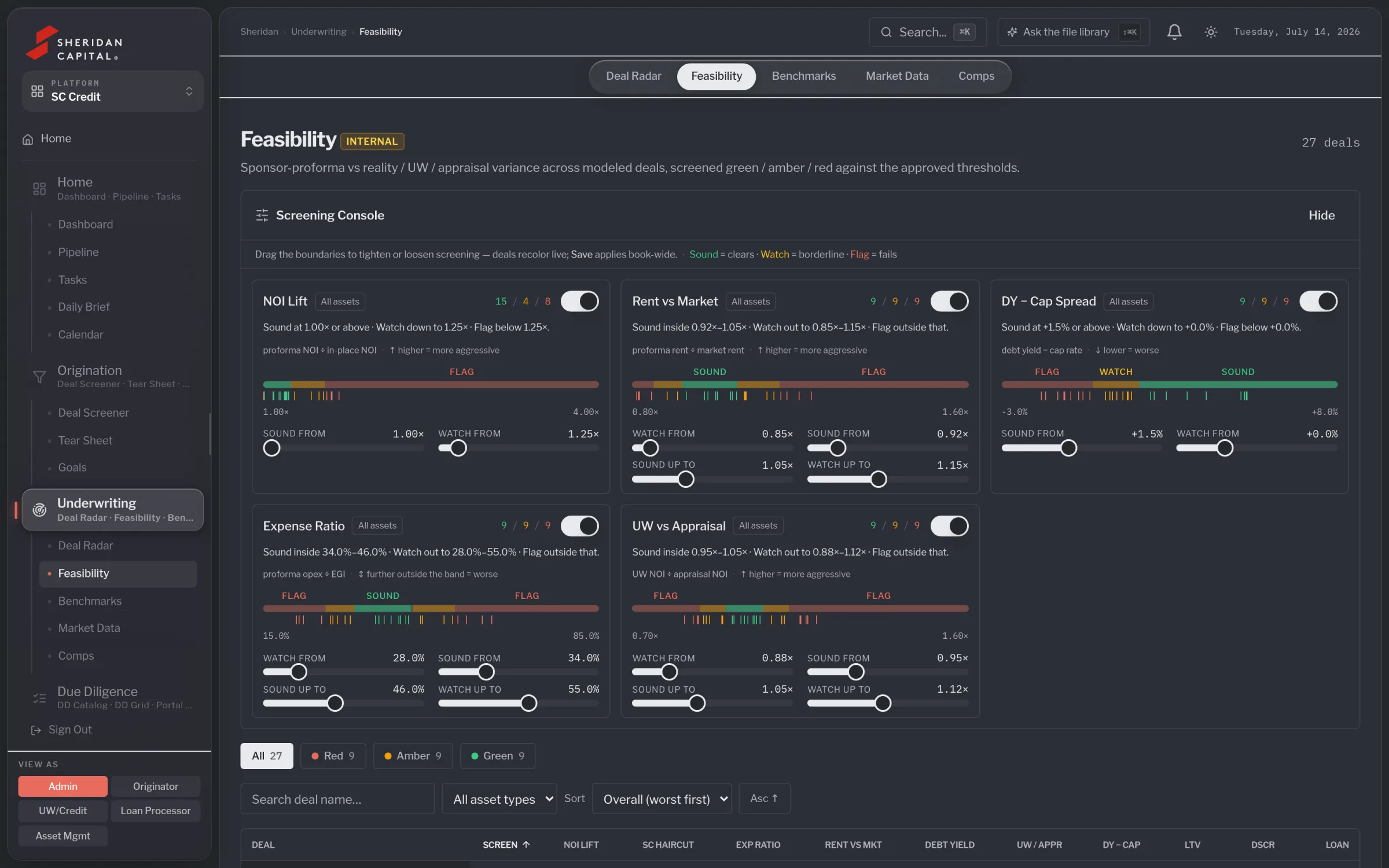
The screen that makes an underwriting standard explicit. Every modelled deal is scored on five axes: NOI lift over in-place, proforma rent against the submarket, debt yield less the appraisal cap rate, proforma expense ratio, and our underwritten NOI against the appraisal's. Each is banded sound, watch or flag against approved thresholds.
The console at the top is the argument. Drag a boundary and the whole book recolors live, so the conversation stops being "is this deal aggressive" and becomes "where should the line be, and how many deals move if we put it there". Save applies it book-wide.
05
/deal-radar
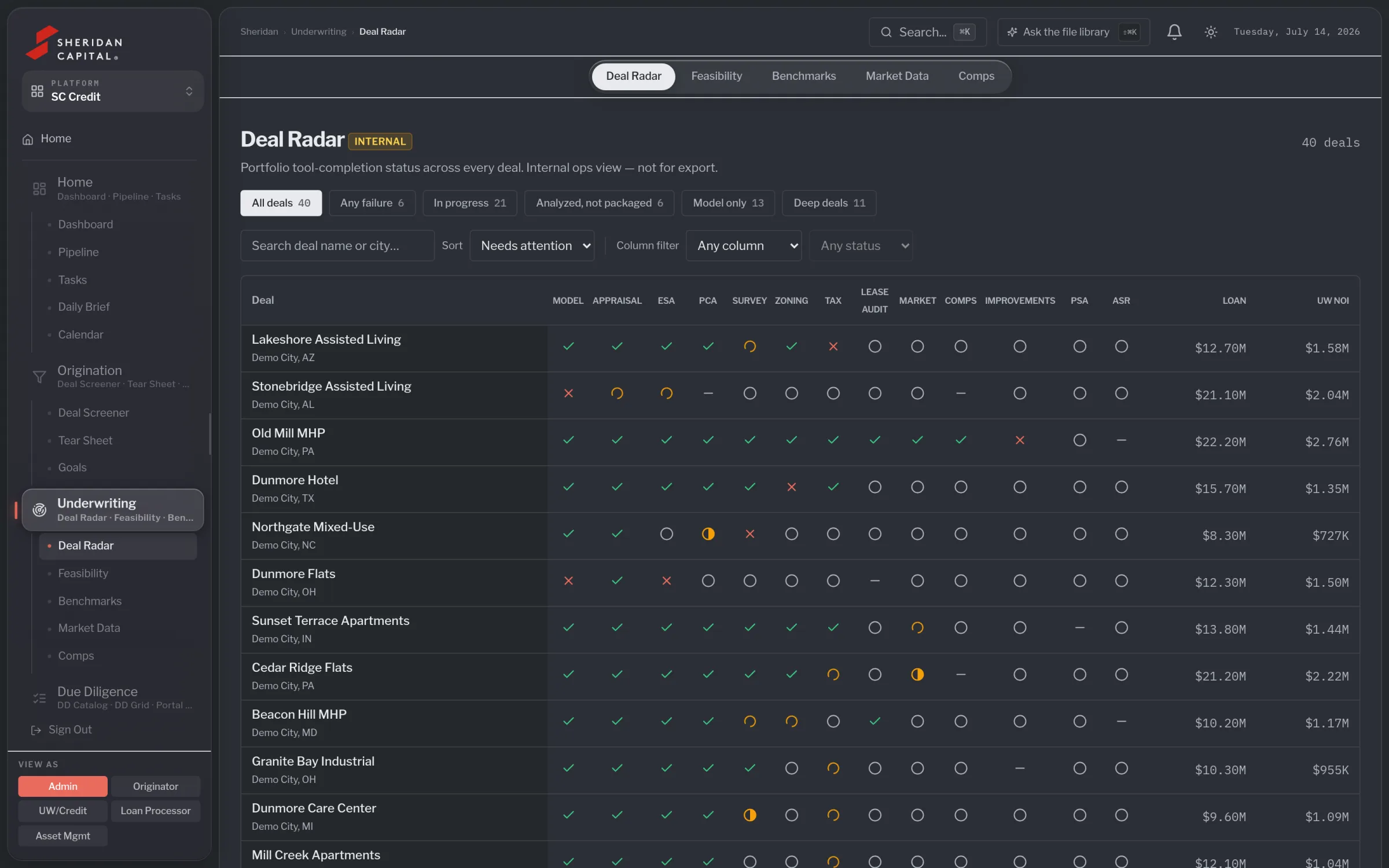
Tool completion across every deal at once. Thirteen columns for model, appraisal, ESA, PCA, survey, zoning, tax, lease audit, market, comps, improvements, PSA and ASR, and one glyph per cell. The presets are the useful part: any failure, in progress, analyzed but not packaged, model only, deep. It answers "what have we half-finished" in a single glance, which is the question nobody remembers to ask.
06
/comps
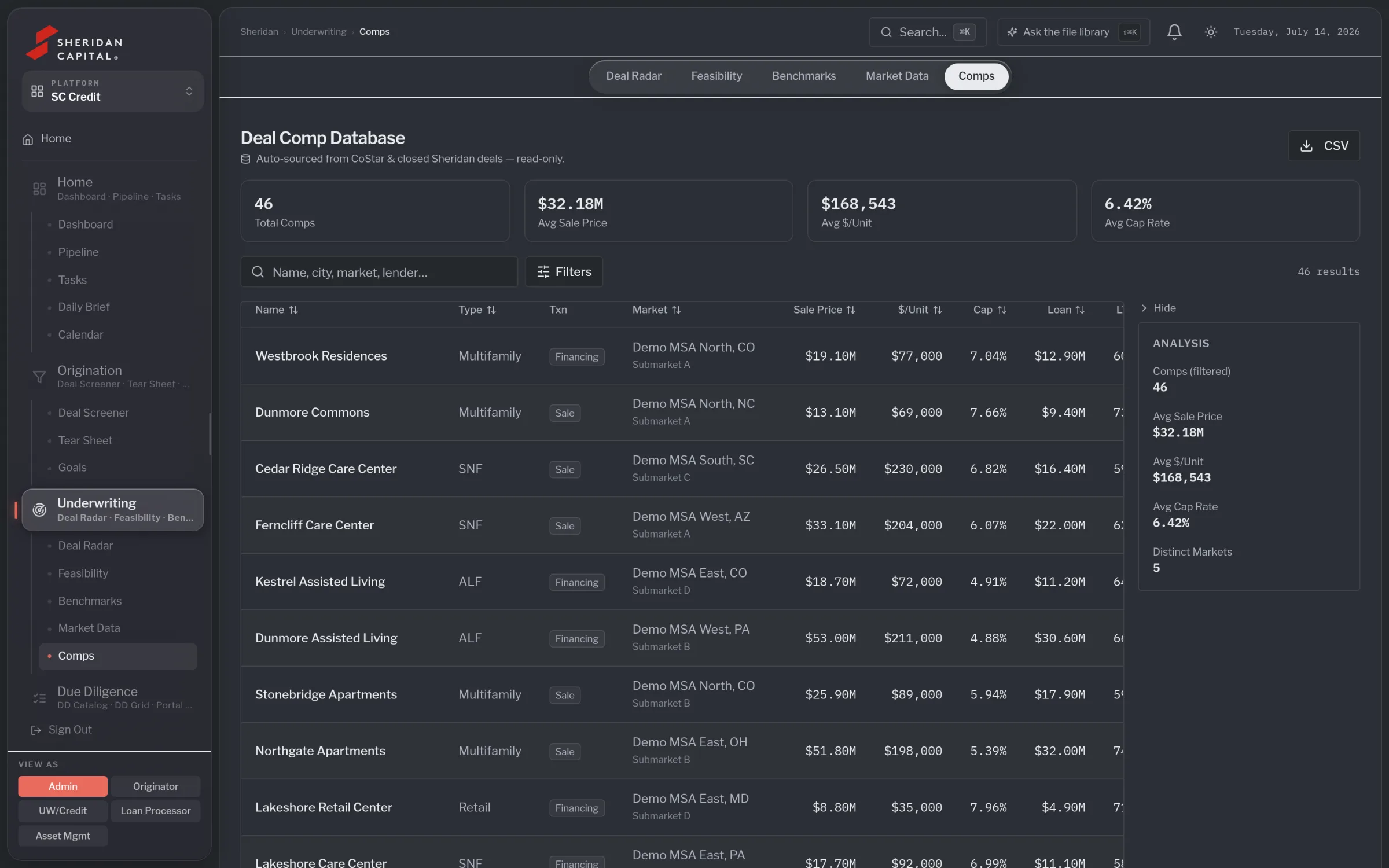
One comp database, drawing on sourced market data, appraisals and our own closed deals, with the source tagged on every row. Price, price per unit, cap rate, loan, LTV, lender and spread, filterable by asset type, market, submarket and date, with the averages recomputing against whatever filter is applied.
07
/market-rent
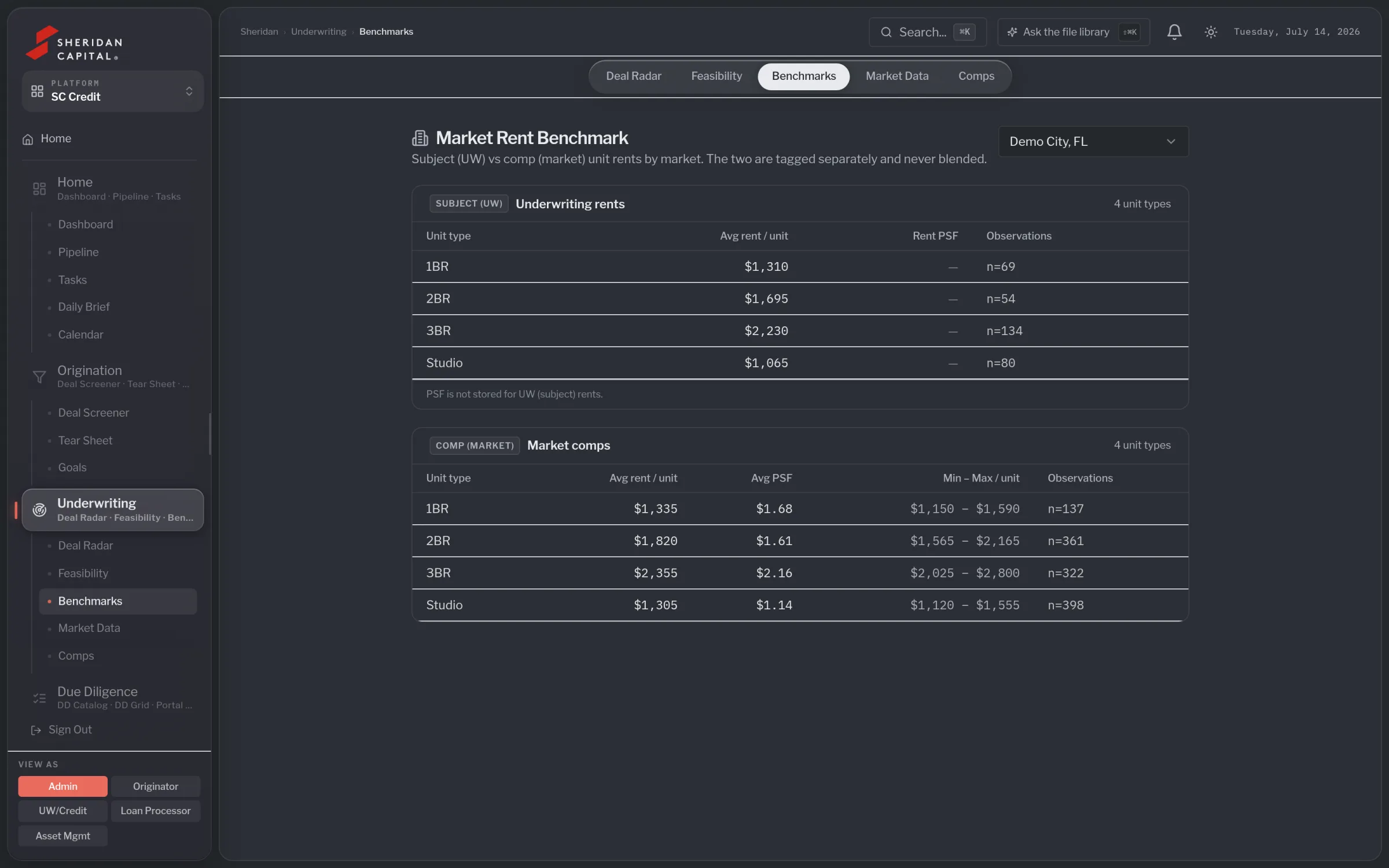
Underwritten rents against market rents, by market and by unit type. The two are tagged separately and deliberately never averaged together, because a subject rent and a comp rent answer different questions and blending them quietly hides the gap that matters. Observation counts sit on every row so you can see how much weight a number deserves.
08
/dd
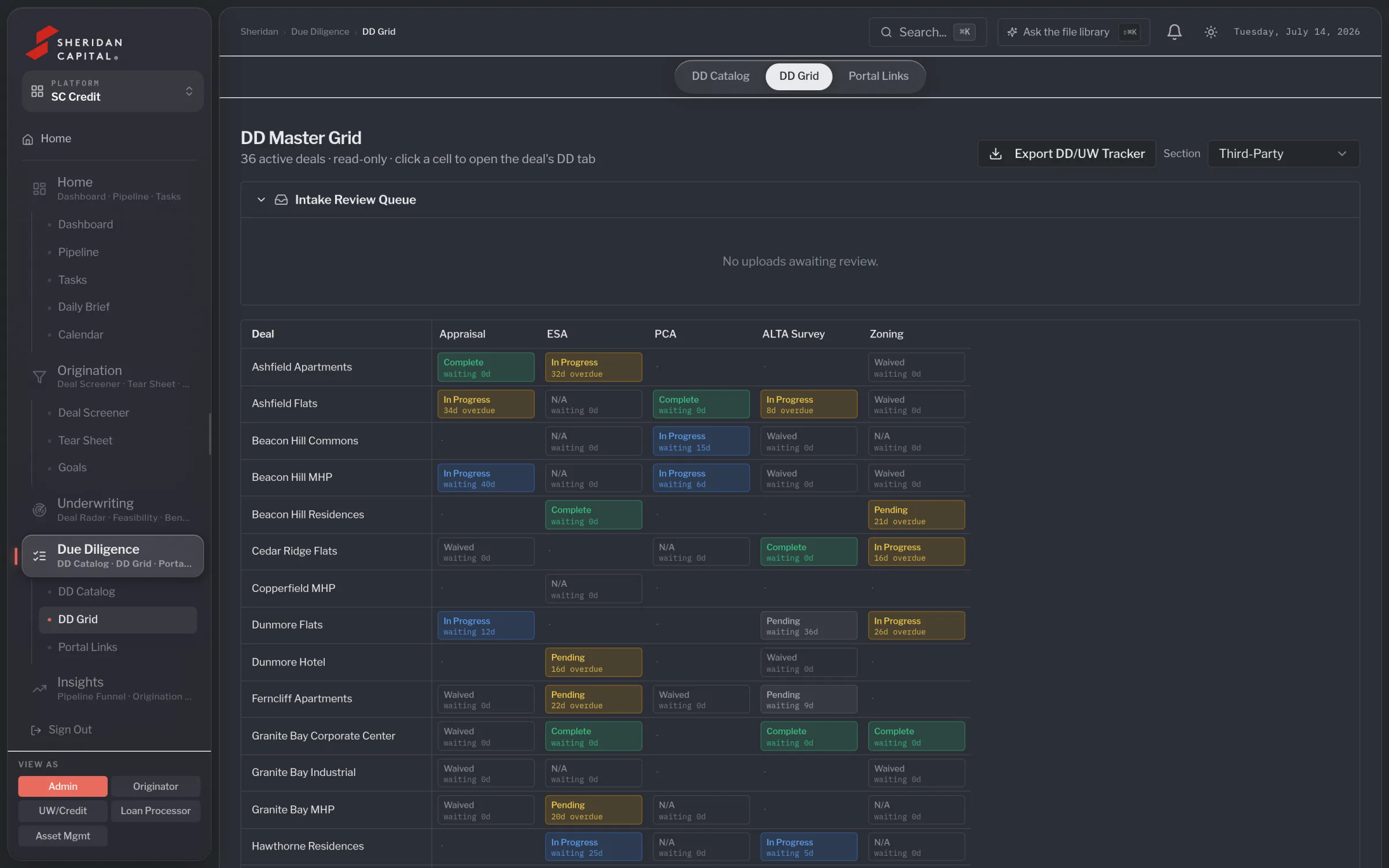
Diligence for the whole active book in one grid, one row per deal, one column per item, switchable by phase: third-party, financial, legal, sponsor, physical, environmental, insurance, zoning. Each cell carries the status and how long it has been waiting, with past-due in amber and badly past-due in red. Click a cell to land on that deal's diligence tab.
09
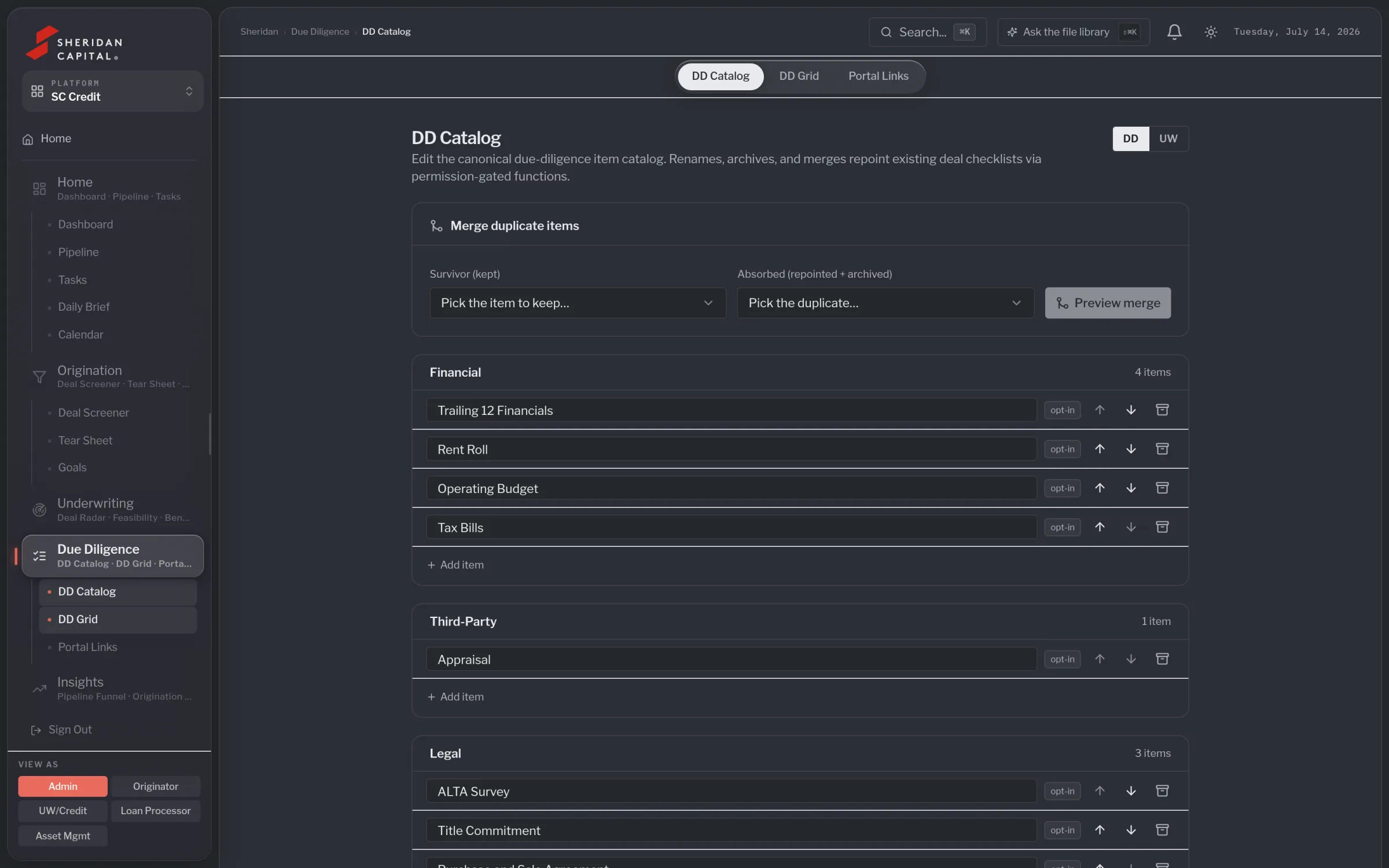
/dd-catalog
The unglamorous thing that makes the grid above possible. Diligence items get called different names by different people, and a checklist where "Phase I" and "ESA" are separate rows is a checklist nobody trusts. So the catalog is a first-class, editable surface: canonical names, aliases that resolve to them, and a merge that repoints every existing deal checklist rather than orphaning it.
10
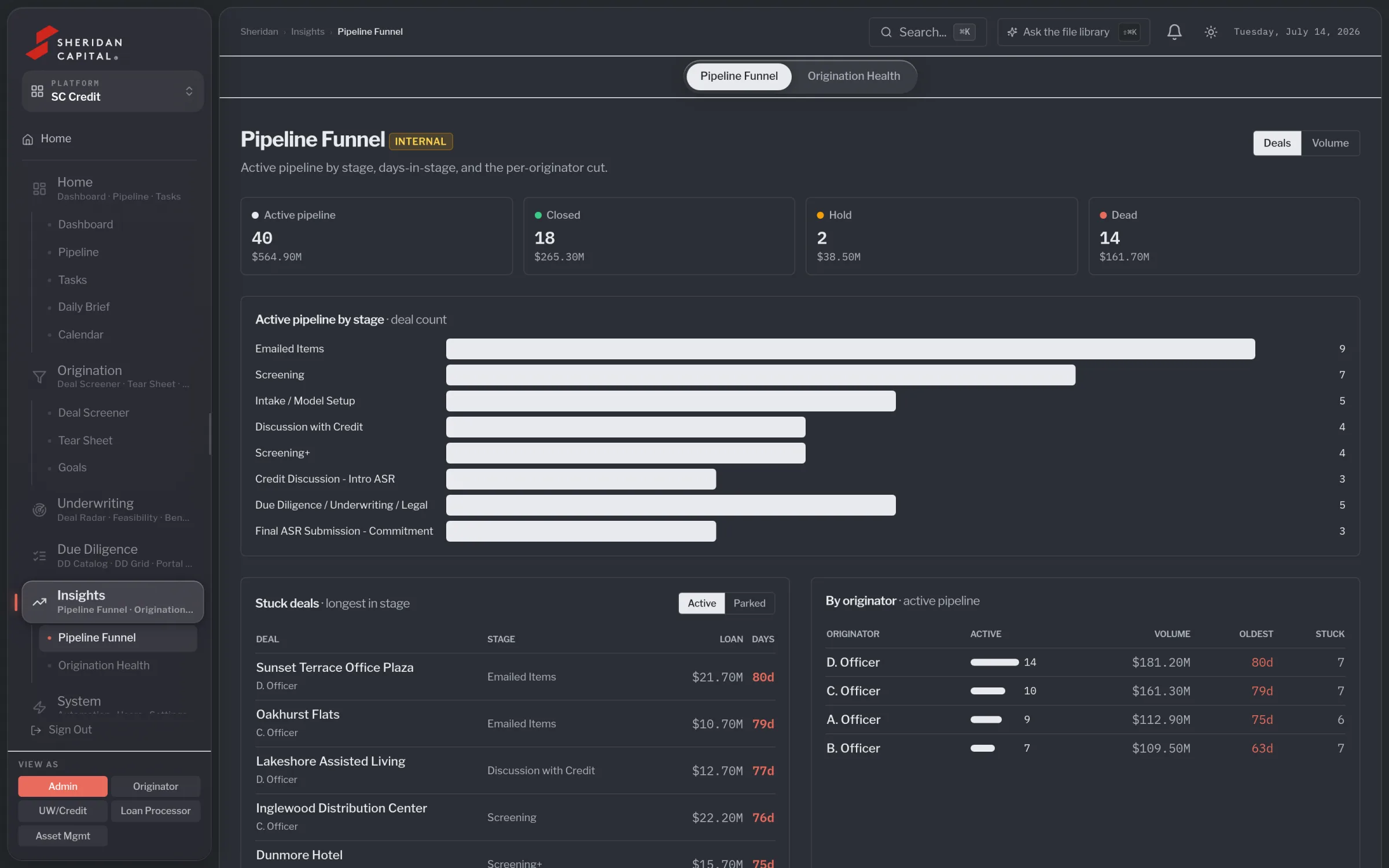
/funnel
Active, closed, hold and dead across the top, then the funnel by stage in either deals or dollars. Underneath, the two views that make it actionable: the longest-sitting deals with their days in stage, and the same pipeline cut by originator with each person's oldest deal and stuck count. Days-in-stage is measured from the last recorded transition, not from creation.
11
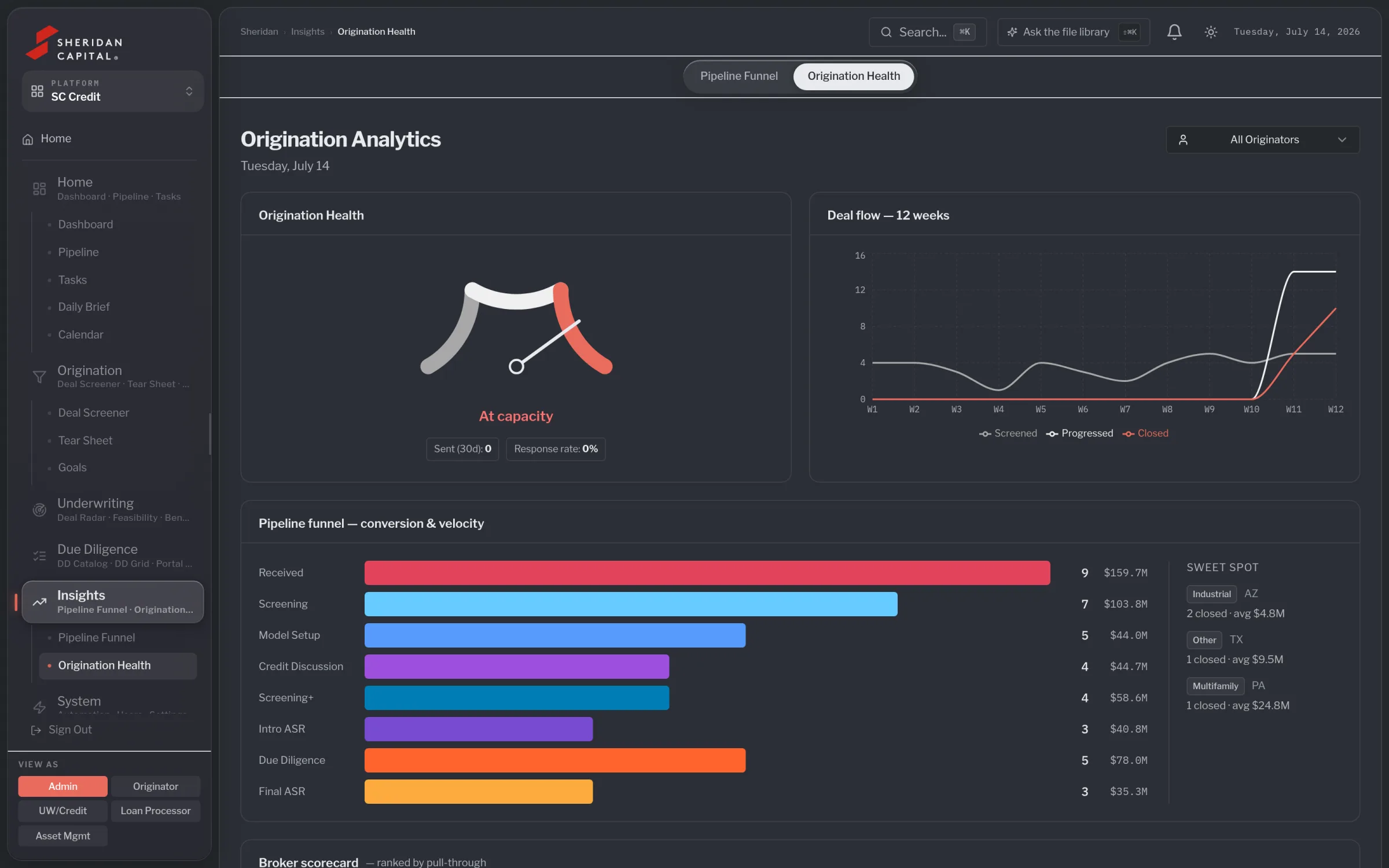
/analytics
Whether the front of the funnel is working. Twelve weeks of screened, progressed and closed, the funnel with conversion and velocity, a broker scorecard ranked by pull-through rather than by volume, and the sweet spot: the asset type and geography combinations that actually convert for us, with what we closed in each.
12
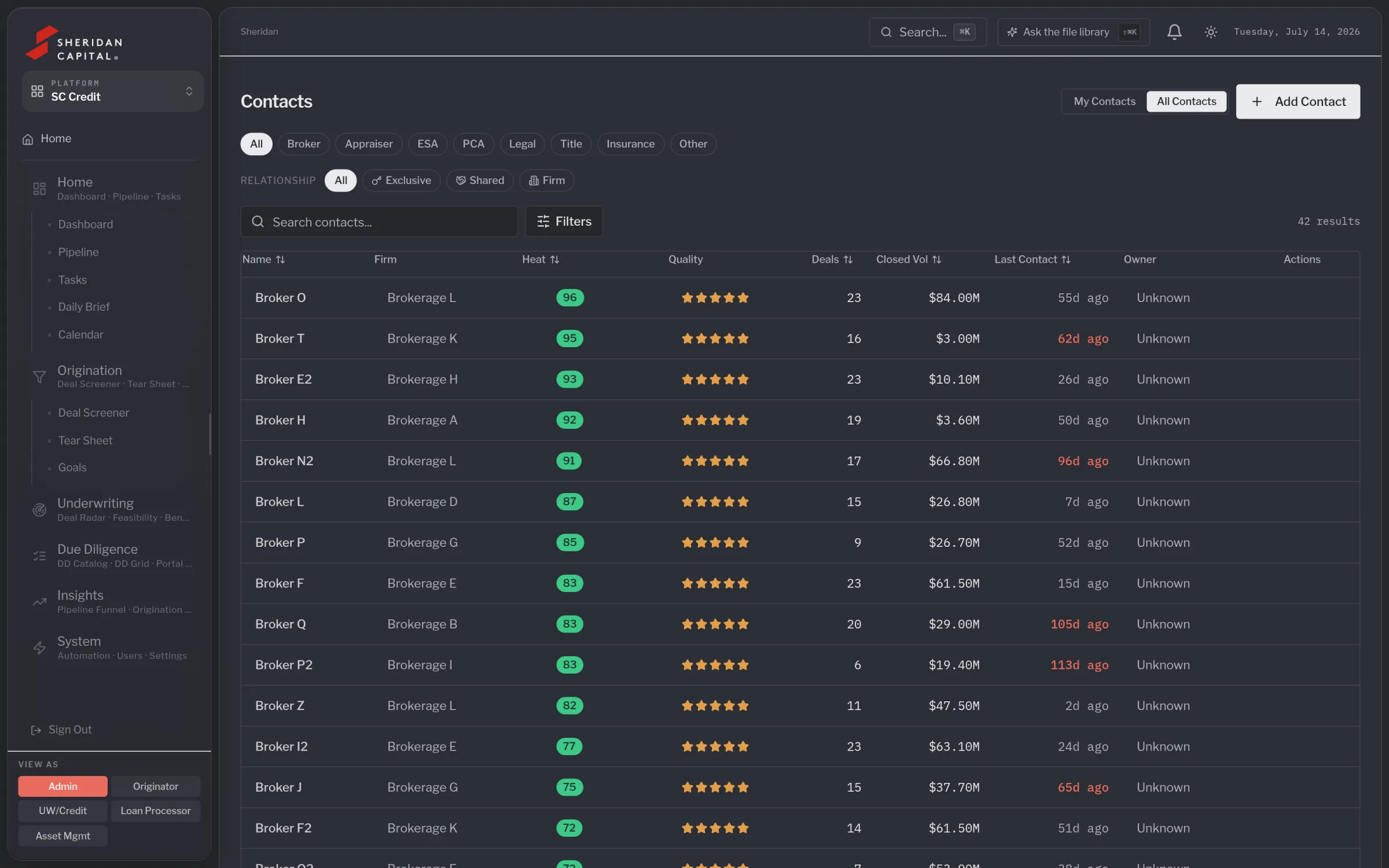
/brokers
Brokers, appraisers, ESA and PCA firms, legal, title and insurance in one book, with a heat score, a quality rating, deals sent, closed volume and how long since anyone spoke to them. Last contact turns red on its own. In a relationship business, the useful list is not who sends the most deals, it is who we have not called.
13
/daily-brief
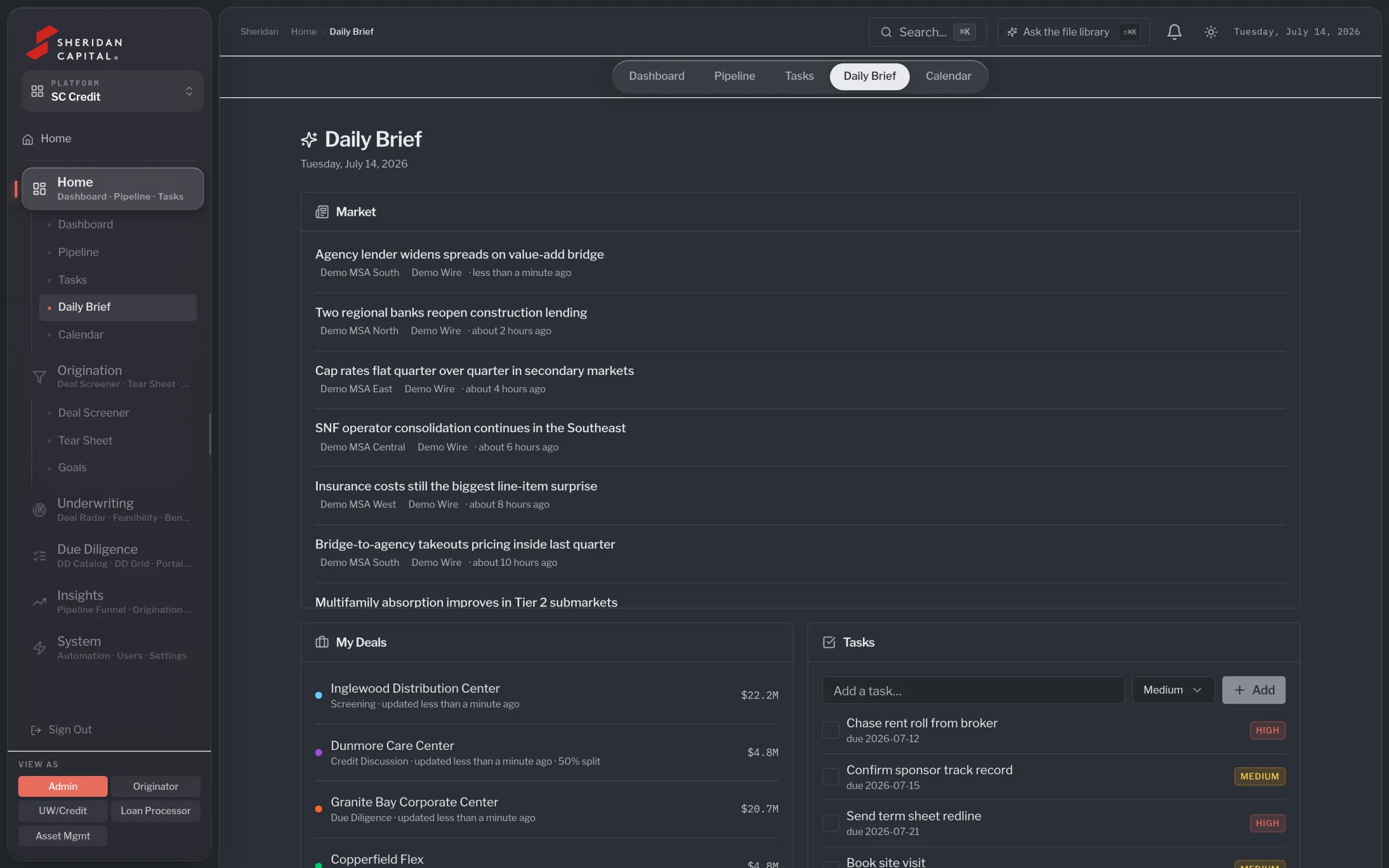
Market intel that landed overnight, tagged by market, above your own connected deals and their current stage, above your open tasks. Three things on one page, which is roughly what fits in the first ten minutes of a day.
14
/goals · /tasks
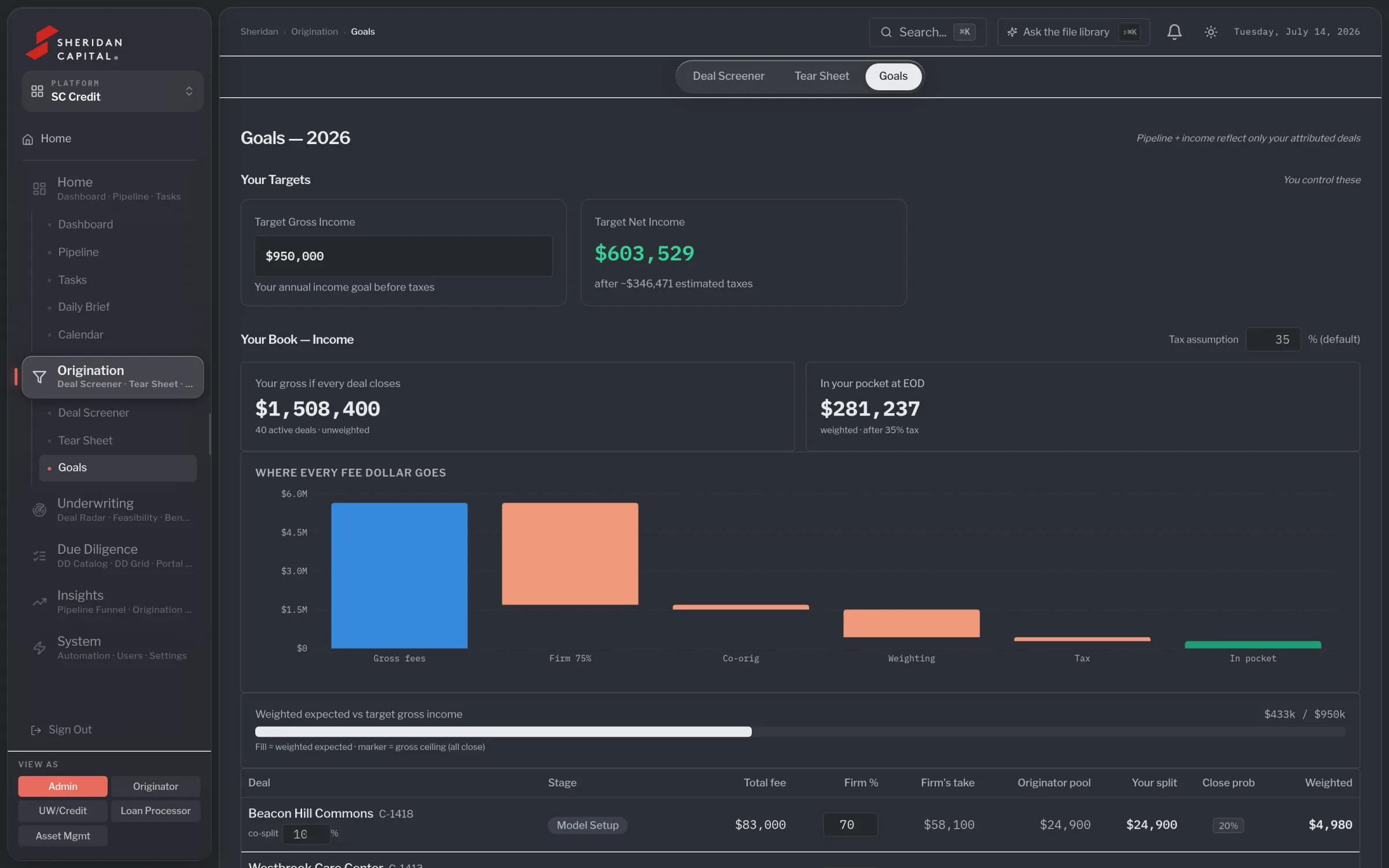
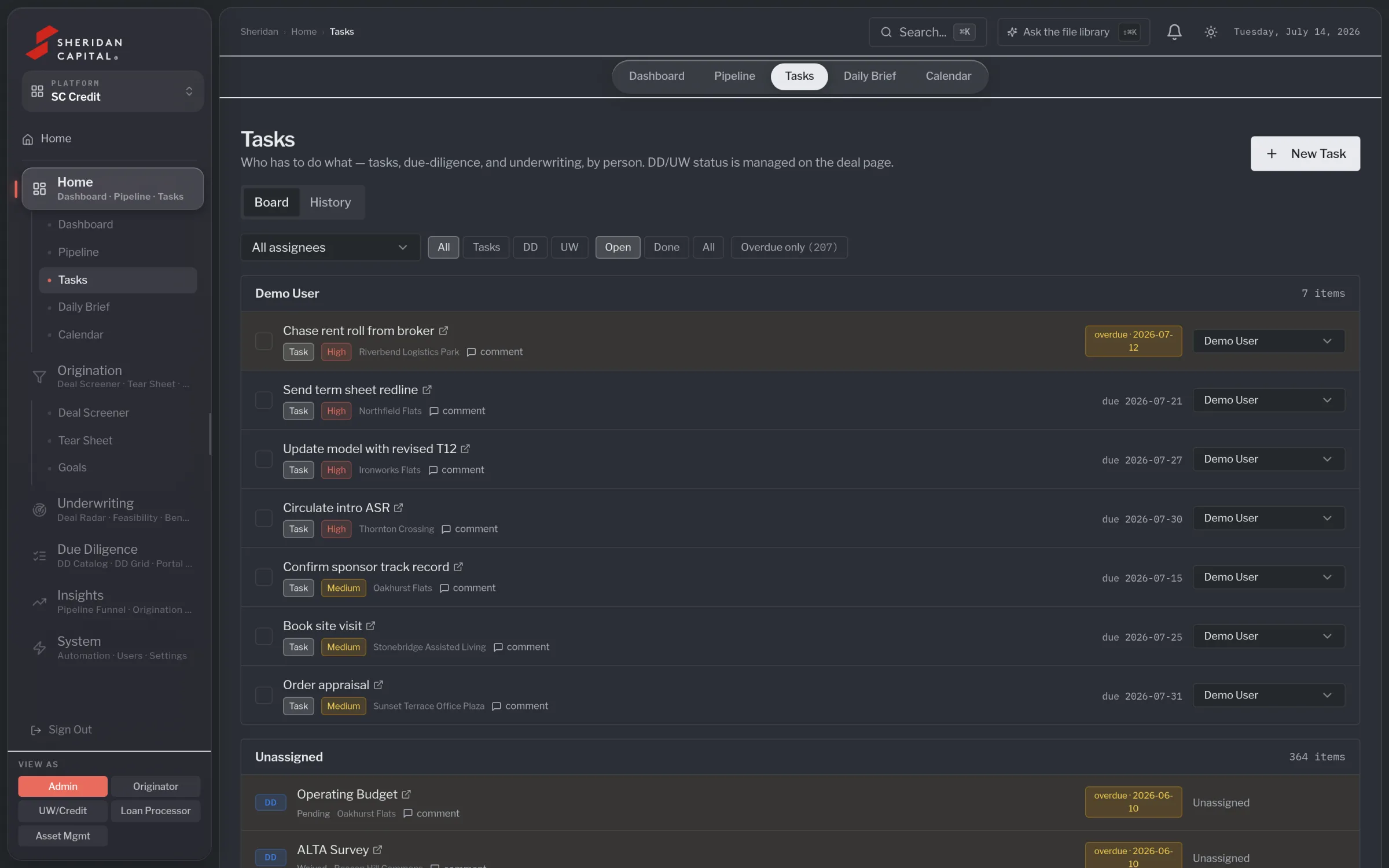
An originator's own book, priced. Every live deal's fee, the firm's share, the co-origination split, the close probability for its stage, and the weighted total against the year's target, with a waterfall showing where each fee dollar ends up. Beside it the task board: tasks, diligence items and underwriting items grouped by who owns them, with overdue counted.
03 How it's built
Same story as the Command Center, and the same reason. No vendor, no implementation period, no consultant learning what a bridge-to-agency takeout is on our clock. Specified and built inside the firm by the people who originate, which is why the sidebar is shaped like the job rather than like a CRM's idea of one.
It shares its sign-in, its design system and its data with the Command Center. A deal that closes here becomes a loan there, and neither side re-keys it.
04 Controls
A screening tool that nobody can inspect is just an opinion with a colour attached. The controls below are the ones that make the numbers on these screens defensible.
05 Close
We built this for our own team.
It isn't a product we're selling and it isn't a demo. It's where our originators start the day, and the reason a deal that came in on Tuesday morning has a defensible answer attached to it by Tuesday afternoon.
The other half of the story is the Command Center, which picks the deal up at close and carries it through asset management and workout.